
Do you ever notice what happens when a wave of anxiety or stress hits?
For many adults, the first instinct is to do everything. You take on extra tasks, overbook your schedule, wake up earlier, and try to control every tiny detail. You tell yourself that if you just stay busy enough and work hard enough, the anxious feeling will go away.
Instead, you end up exhausted. You hit a wall of total burnout, feel like a failure, and collapse. After resting just enough to regain a little strength, a familiar thought creeps back in: “Maybe if I just try harder next time, I can pull it off.”
This is the anxiety-burnout-depression cycle. It is a very common pattern, but running on this treadmill will eventually drain your mental and physical health. Understanding how this cycle works is the first step toward breaking free and finding real balance.
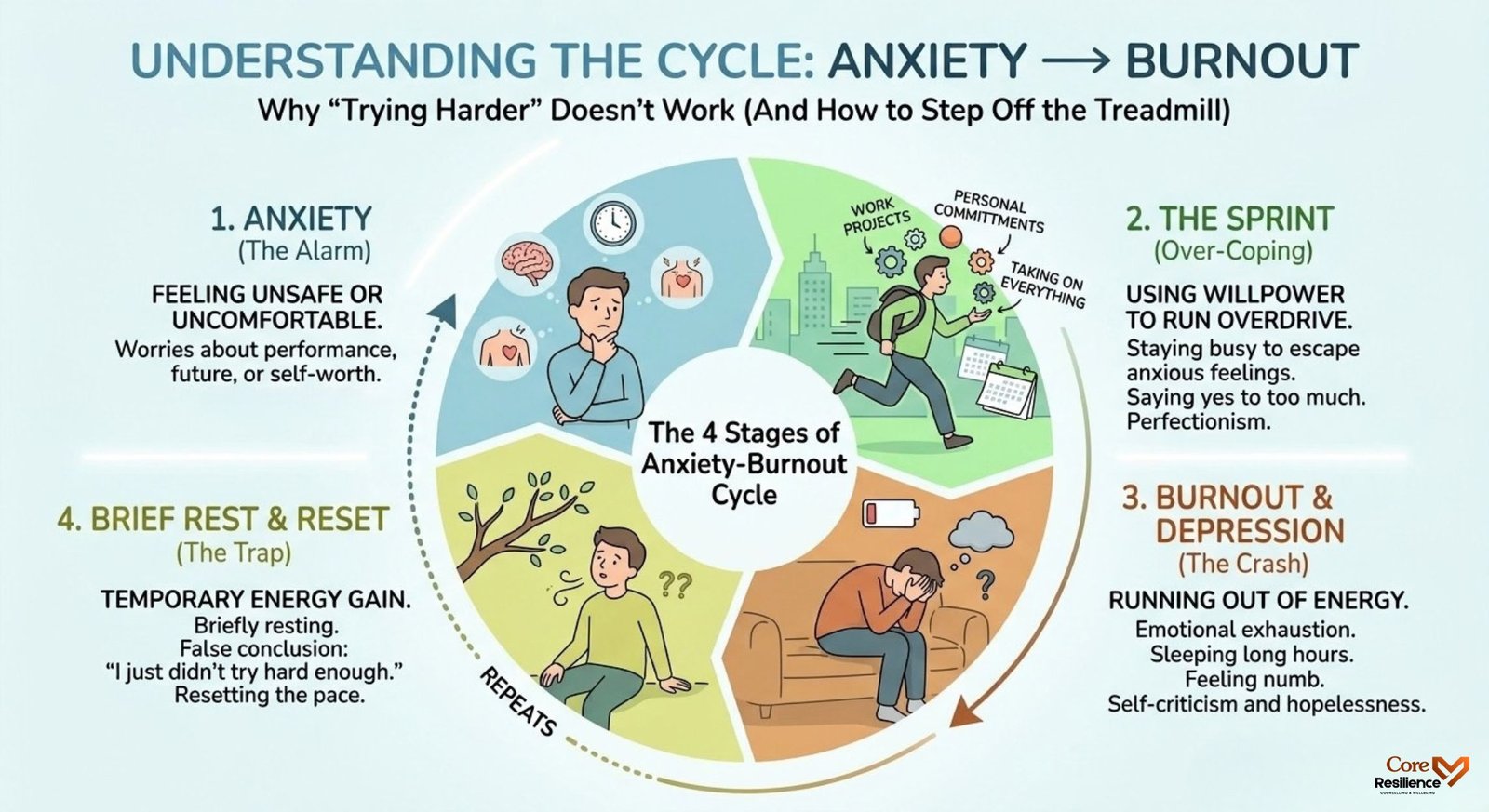
The 4 Stages of the Cycle
Stage 1: Anxiety (The Alarm)
Anxiety often starts as an uncomfortable feeling in the body or mind. It might feel like a tight chest, a racing heart, or a constant sense of dread. You might worry about your job, your finances, your relationships, or simply feel an underlying fear that you are “not good enough.” Because anxiety feels so unsafe and uncomfortable, your natural response is to want to escape it or fix it immediately.
Stage 2: The Sprint (Over-Coping)
To quiet the anxiety, you switch into overdrive. You use pure willpower to outrun the uncomfortable feelings.
During this stage, you might:
- Say yes to too many projects at work.
- Start strict routines or take on heavy personal commitments.
- Try to be perfect in every area of your life.
The subconscious thought driving this behavior is: “If I can just do everything right, I won’t have to feel anxious.” But this is like a short-distance sprint. You cannot run at top speed forever.
Stage 3: Burnout and the Depressive Crash
Eventually, your body and nervous system run out of energy. The sprint comes to a sudden stop. You enter burnout, which quickly turns into deep exhaustion and low mood. You might sleep for long hours, feel emotionally numb, or struggle to complete simple daily tasks. Because you put all your effort into “fixing” things and still collapsed, you start to criticize yourself. You might ask, “Why can’t I handle this?” or feel like a complete failure.
Stage 4: Brief Rest and the “Reset” Trap
After spending days or weeks in burnout, your physical body slowly recovers a small amount of energy. But instead of changing the pattern, your mind misinterprets what happened.
You tell yourself: “I wasn’t weak, I just didn’t try hard enough.”
As soon as life demands build up again, anxiety returns, you sign up for new tasks, and the cycle starts all over.
Why “Sprinting” Always Fails
Your brain’s stress response was designed for short bursts of danger—like running away from immediate physical harm. It was never meant to be used to manage everyday work stress, career shifts, or ongoing life transitions.
When you treat daily life like a non-stop sprint, your nervous system eventually shuts down to protect you. Pushing yourself through fear, guilt, and harsh self-criticism may work for a few days, but over time, it strips away your motivation and health.
How to Break the Cycle at Every Stage
You do not have to stay trapped in this loop. You can step off the treadmill by making small, conscious changes at each phase.
At Stage 1: Focus on Grounding, Not Fixing
When anxiety arises, resist the urge to immediately fix everything in your outer life. Slow down. Use simple physical grounding tools—like slow deep breaths, touching a physical object, or stepping outside—to signal to your body that you are safe in this moment.
At Stage 2: Trade the Sprint for a Sustainable Pace
Notice when you are filling your calendar just to avoid feeling nervous. Practice saying no to non-essential requests. Remind yourself that doing less at a steady pace is far healthier than doing everything until you collapse.
At Stage 3: Replace Self-Criticism with Self-Compassion
If you hit burnout, treat yourself with the same kindness you would show a friend who is sick or exhausted. Pushing yourself harder when you are already drained will only deepen the depression. Allow yourself to rest without guilt.
At Stage 4: Learn from the Pattern
Instead of assuming you failed due to a lack of effort, look at the big picture. Journal about what triggered the cycle. Recognize that burnout is not a sign that you need to try harder—it is proof that your current pace is unsustainable.

5 Signs It May Be Time to Seek Therapy
Breaking long-standing habits alone can feel overwhelming, especially when your energy is low. Professional anxiety therapy or support for burnout and stress can help you rebuild a healthier foundation.
Here are five clear signs it may be time to reach out to a professional:
- Your only way of managing stress is to overwork: You don’t know how to handle uncomfortable feelings without filling your schedule to capacity.
- Rest no longer recharges you: Even after sleeping or taking time off, you still feel drained, empty, or detached.
- Self-criticism is your main motivation: You rely almost entirely on guilt, fear, and harsh internal talk to get through your day.
- You feel numb to life: You go through the motions at work and home, but you feel disconnected from the things and people you used to care about.
- You feel hopeless about the future: You feel stuck in an endless loop and cannot see a way out on your own.
How Online Therapy Can Help
Taking the first step toward mental health support should not add more pressure to your life. For many adults balancing heavy workloads and burnout, online therapy offers a practical and gentle way to begin.
- No Commute Stress: You can meet with a trained therapist from the comfort of your home or private space, saving precious time and energy.
- A Safe, Private Environment: Therapy gives you a space where you can drop the “I have it all together” mask and speak honestly about your struggles.
- Practical Tools: A therapist can help you identify your personal triggers, build real-time grounding skills, and create realistic boundaries for work and life.
- Sustainable Growth: Instead of quick fixes, therapy guides you toward building true, lasting mental resilience step by step.
Moving away from the “try harder” mindset takes time, but you do not have to do it alone. By slowing down, listening to your body, and getting the right support, you can break the cycle and rebuild a life based on balance, energy, and genuine calm.